
PERSONALISED PLANS
ABOUT
YEAR: October 2023 — February 2024
INDUSTRY: Edtech
MY ROLE: UX Research, Prototyping, UX/UI Design
TEAM: Lead Designer (me) | Product Manager | 7 Engineers
PLATFORM: Web
PROJECT DETAILS
Conducting focused learner experience research in 2023 revealed that Degreed was not adequately supporting learners in identifying their learning needs, addressing skill gaps, or effectively tracking their progress.
APPROACH
We conducted in-depth research to map out the typical learner journey within Degreed, allowing us to pinpoint key opportunity areas for enhancing and adding value to the overall learner experience.
SOLUTION
We created Personalised Plans to enhance the platform’s ability to guide learners in personalizing their learning journeys, bridging skill gaps more efficiently, and providing better tools for tracking and measuring their development.
User Research with Learners
The primary problem identified in the Degreed learner experience was the lack of clear guidance for learners, particularly around defining goals and tasks. The platform catered more to self-driven users or compliance needs, leaving less engaged users without a structured learning experience.
Survey results showed that while learners were primarily motivated by career advancement and skill growth, many struggled with goal setting and tracking. There was also a significant gap in managerial feedback and support for learners’ professional growth.
The introduction of a personalised plan, using learner inputs combined with AI-generated content curation, aimed to provide a clear learning path, suggest hands-on practice, and highlight skill gaps to help learners stay focused and engaged.
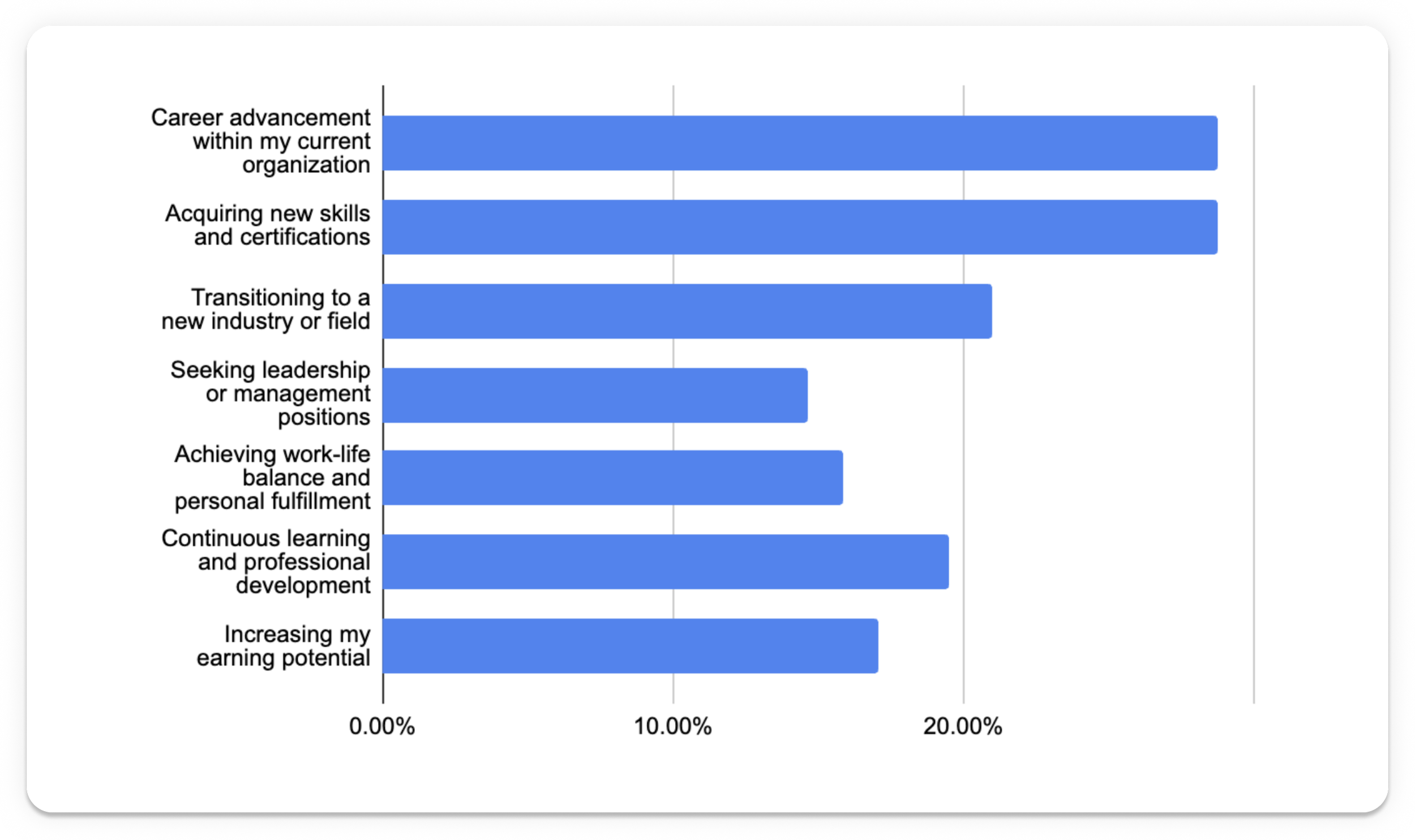
Overall learner goals from survey results
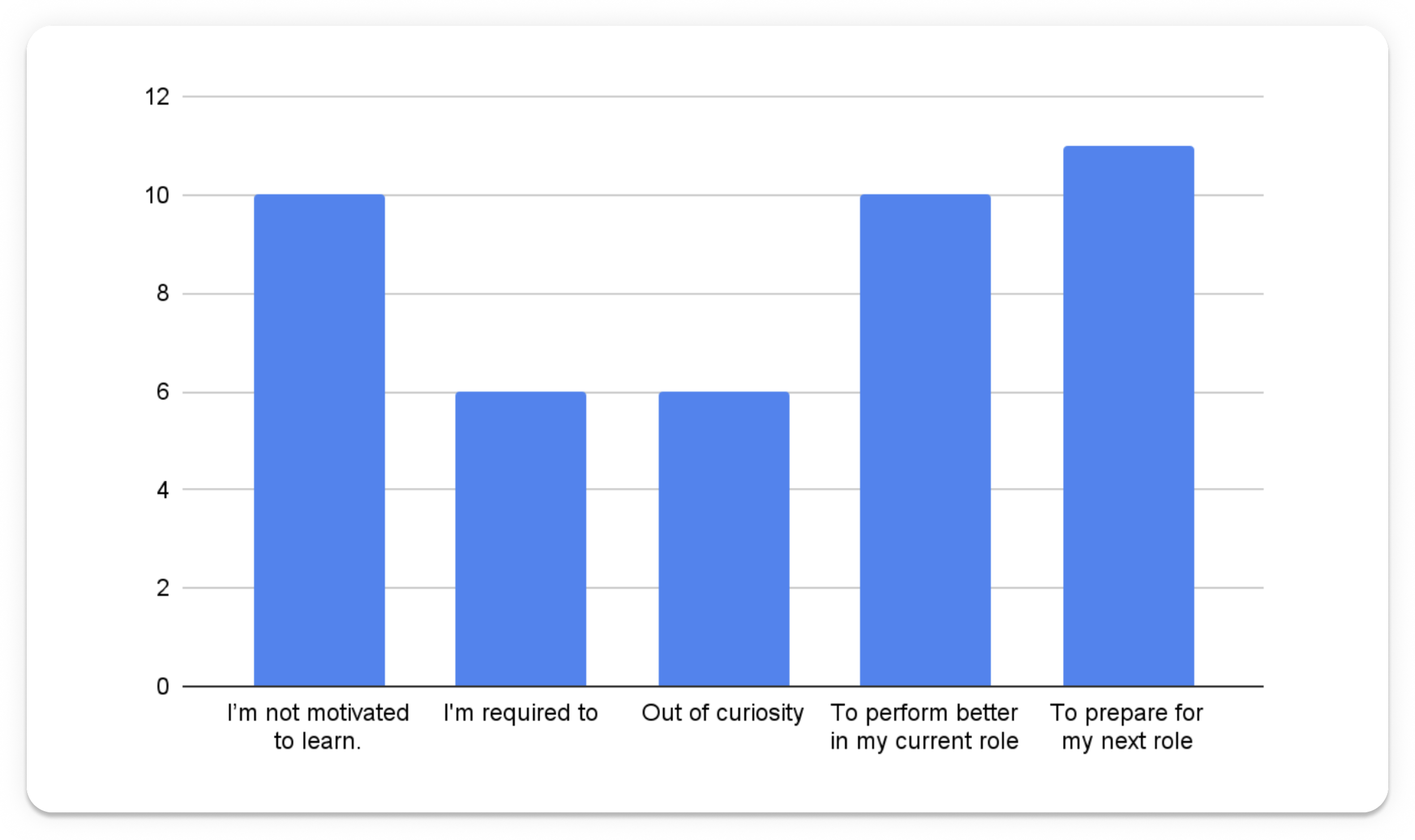
Motivation to learn stats
Motivation to Learn and Grow
Early research also revealed that many learners lacked motivation for self-directed learning, and Degreed was not offering the necessary tools to help them take ownership of their learning journey or work proactively toward clear, tangible goals.
For most, Degreed was viewed primarily as a platform to complete mandatory, company-assigned training, rather than as a tool that nurtured curiosity or encouraged exploration.
Empowering learners with opportunities for self-driven learning, fostering exploration of new topics, and promoting autonomy in their professional development could significantly enhance their engagement and growth.
Extensive research with over 20 learners and clients was conducted to understand learner behaviours and needs. Three key learner personas were identified:
Career Advancers: Learners pursuing career changes or promotions who needed to identify and fill skill gaps efficiently with limited learning time.
Role Developers: Newer learners looking to develop specific skills but unsure where to begin, seeking structured guidance and relevant content.
Curiosity-Driven Learners: Learners interested in industry trends and new technologies, focused on keeping skills up to date without immediate career changes.
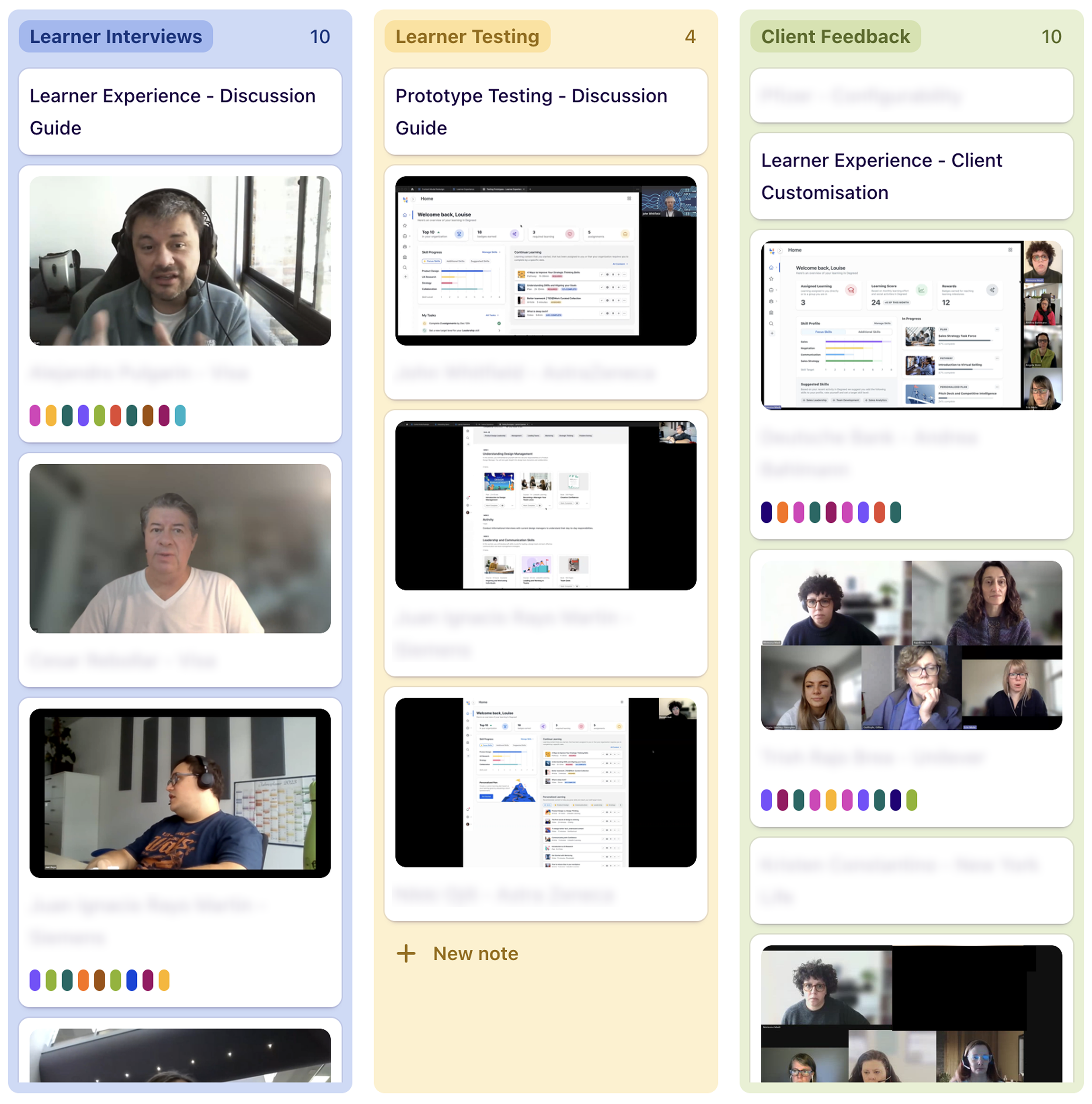
Identifying Learner Personas
One of the core product principles we emphasised was leveraging Artificial Intelligence to guide learners and provide proactive recommendations to support their career growth.
Through our research, we discovered that learners highly valued the following:
A comprehensive summary of their current skill profile.
Assistance in identifying skill gaps.
Relevant suggestions for future roles aligned with their career ambitions.
Personalized learning plans tailored to their career goals and unique skill sets.
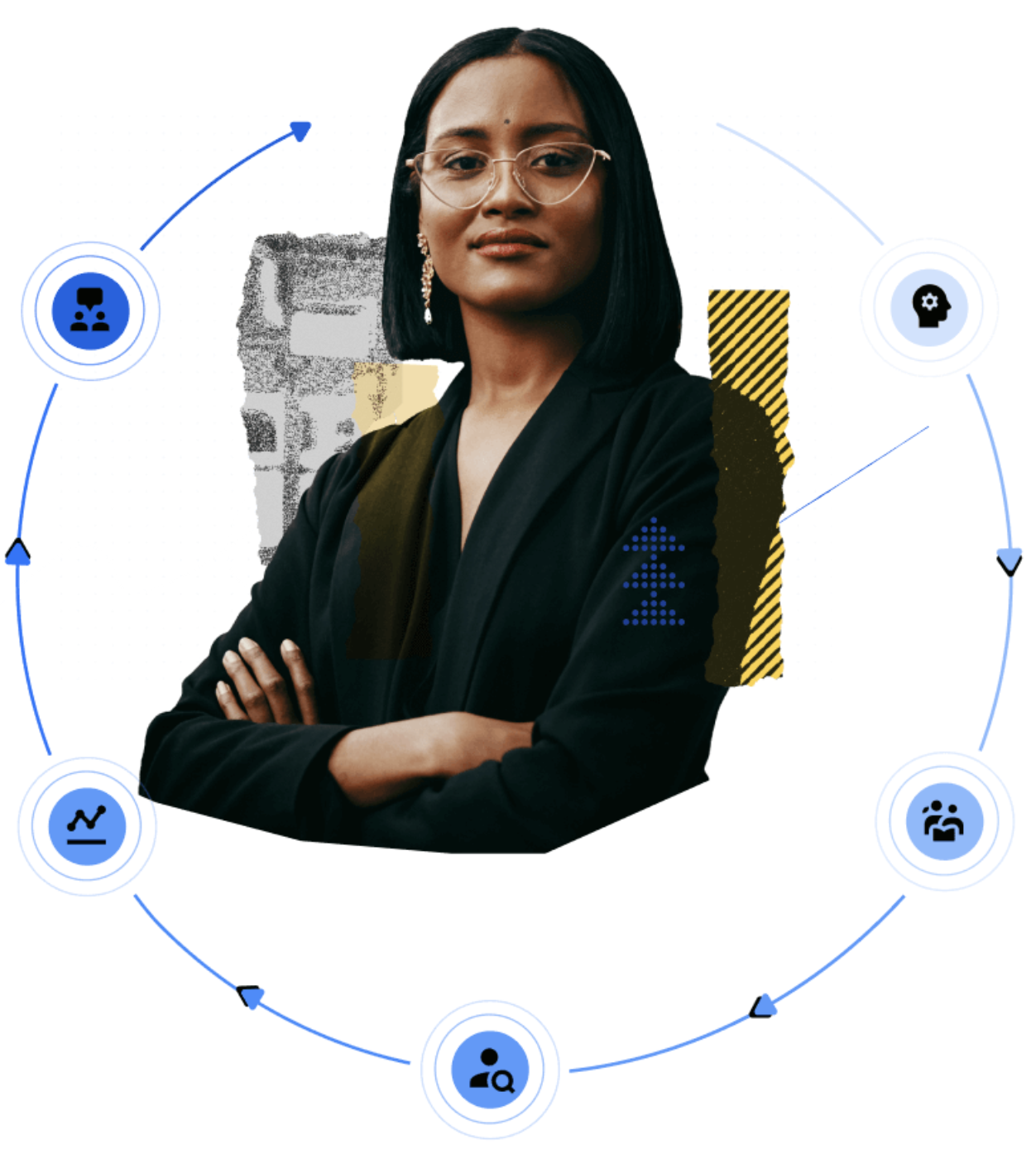
AI-powered Learning Experience
Introducing Personalised Plans
The proposed solution focuses on integrating a personalised learning experience within the Degreed ecosystem. Learners answer a series of questions about their career ambition, current role, and available time for learning. Based on their inputs, the platform generates a tailored plan that tracks their progress, suggests relevant practice activities, and provides curated content aligned with their specific career objectives.
A personalised plan:
Provides a structure to track progress and organize content
Suggests hands-on practice or ways to implement new learning with a new activity type
Shows learners their skillset and what they need to meet their learning goals
Engages learners with a clear learning focus for each visit
Breaks down large learning programs into smaller weekly bundles
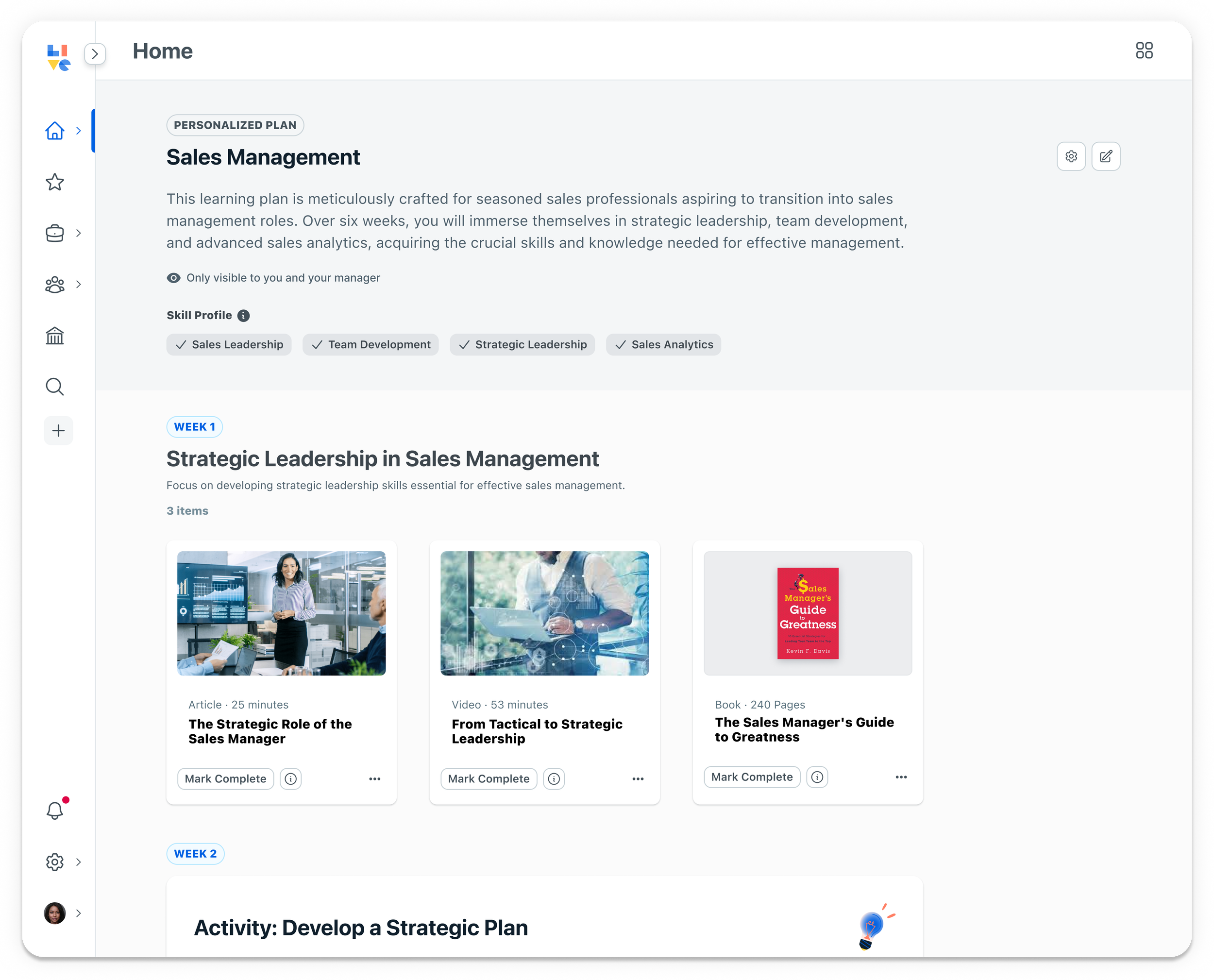
Personalised Plan with AI-curated content and activities
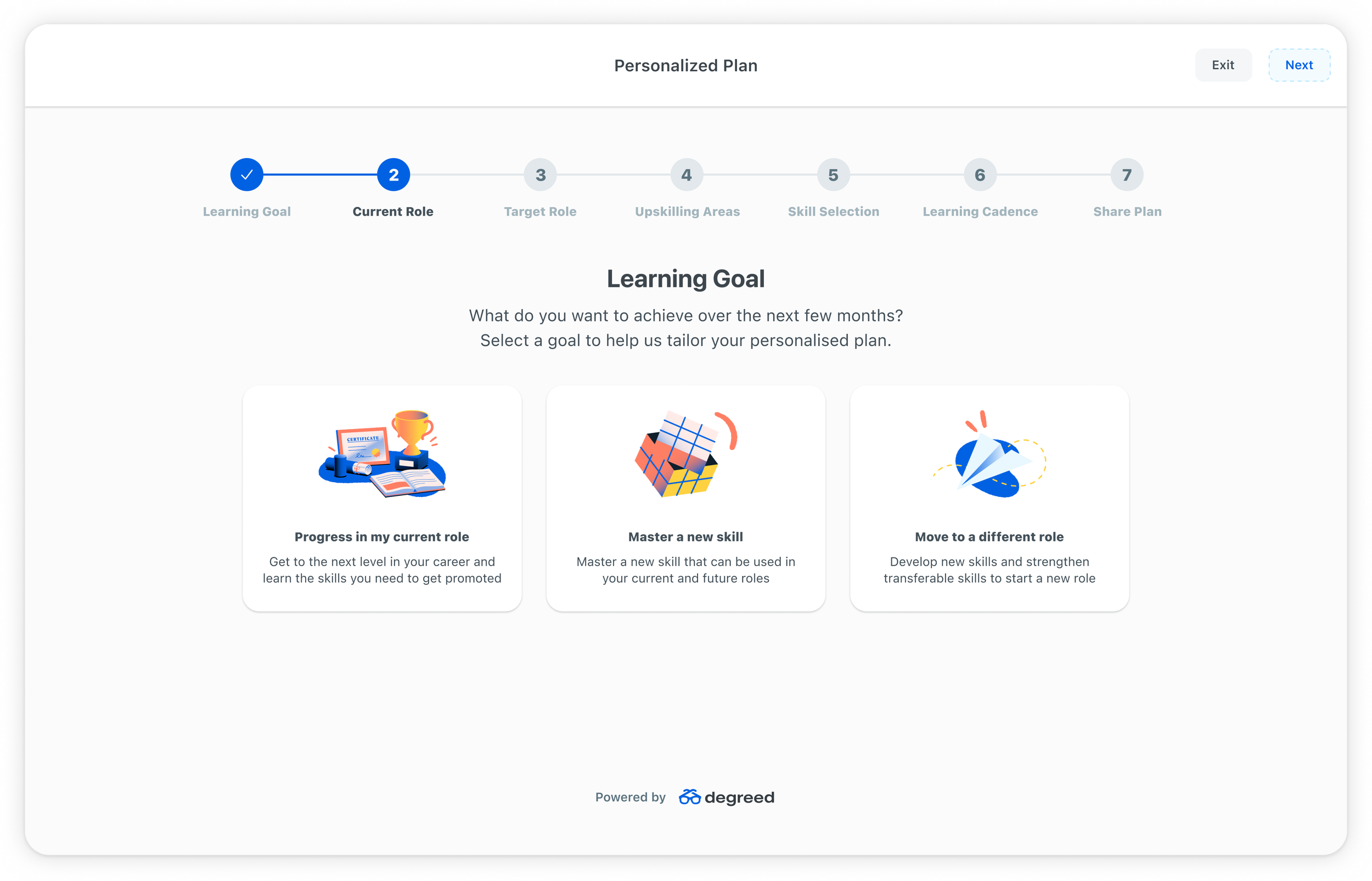
Step One: Learning Goal Selection
The first step in the personalised plan creation process prompts learners to select a learning goal. They can choose from three options:
Progress in my current role: Advancing their career by growing into a recommended target role.
Master a new skill: Focusing on developing a single skill, guided by personalized recommendations.
Move to a different role: Acquiring new and transferable skills to transition into a different career path.
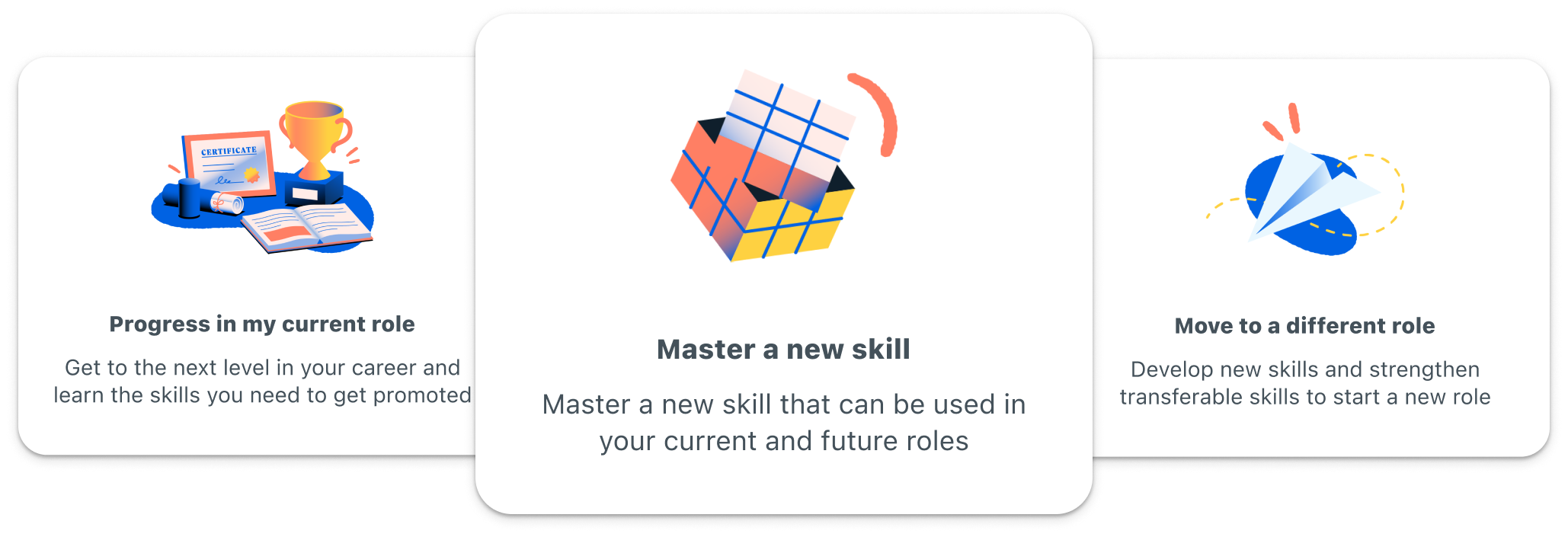
Learning goals options
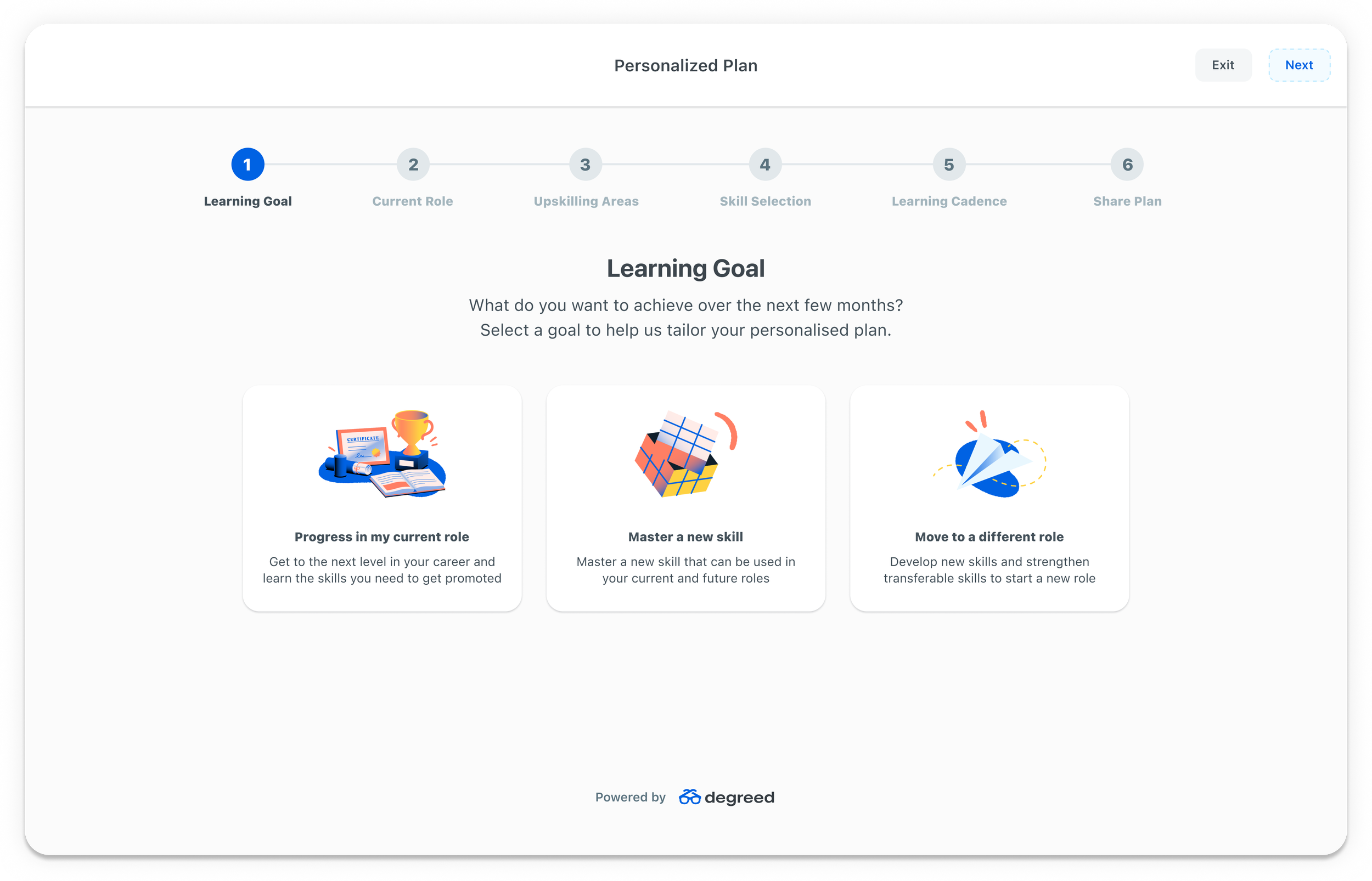
Step one: learning goal selection
Step Two: Suggested Target Role
In this step, we ask learners to confirm their current role and use AI to recommend a typical next role based on the learner’s unique profile. We leverage various algorithms and data-driven techniques to match learners with suitable roles.
Here's an outline of the datasets used to inform recommendations:
Current learner role
Learner profile and learning history data in Degreed
Learner skillset, qualifications and experiences as outlined in their learner’s profile
Current industry and company type
Typical career progression for other learners with a similar profile or skillset
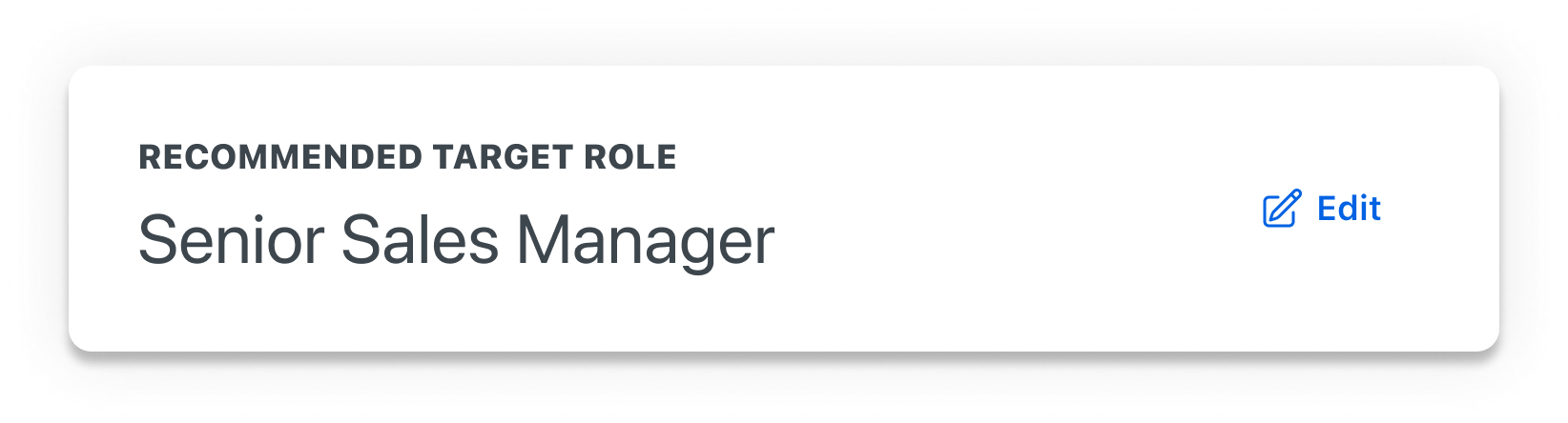
Recommended target role
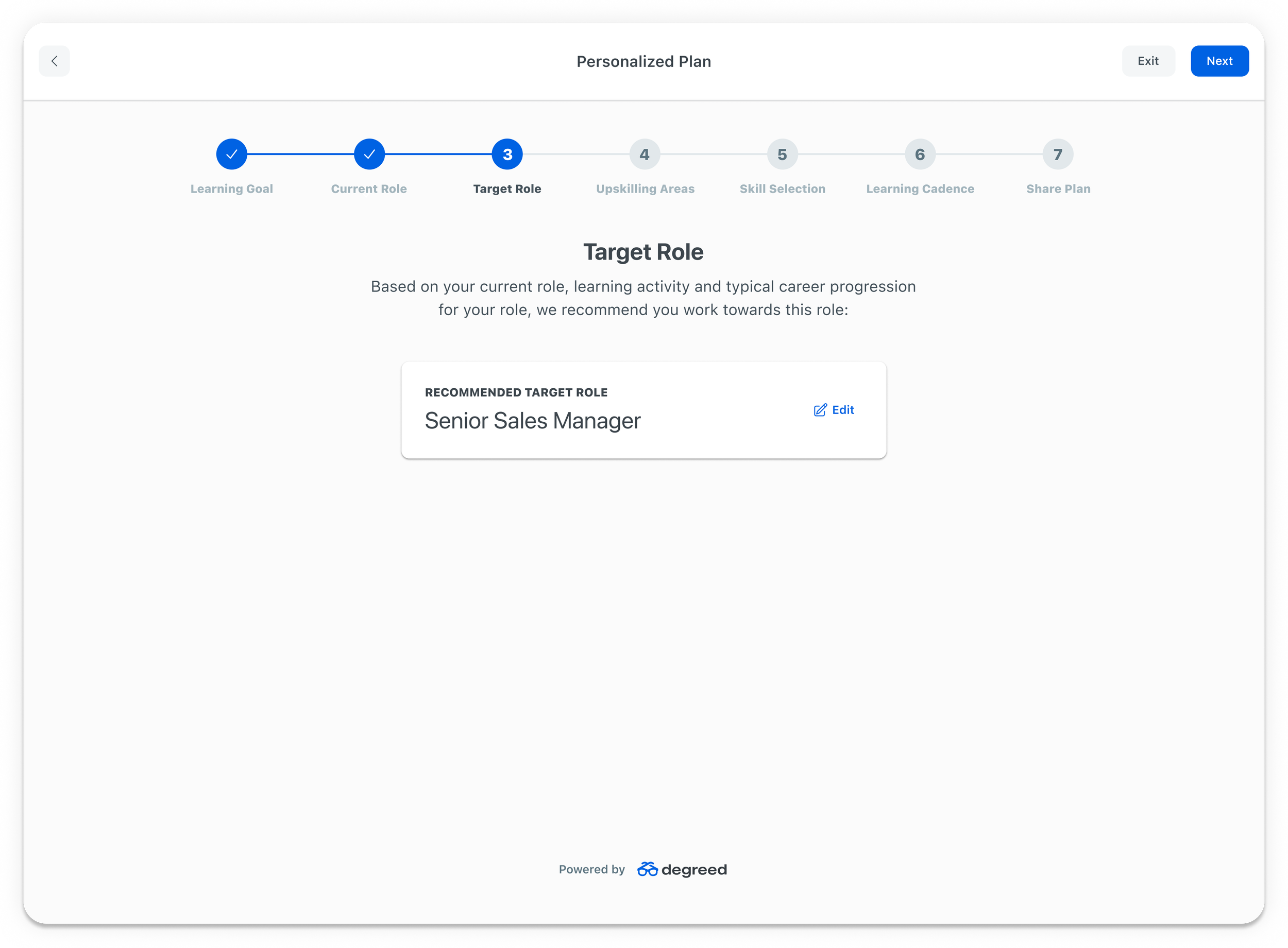
Step two: target role recommendation
Step Three: Identifying Skill Gaps
In this step, we ask the learner to review skill profiles for their current and selected target role. The graph visually overlaps both skill profiles to help quickly identify growth areas.
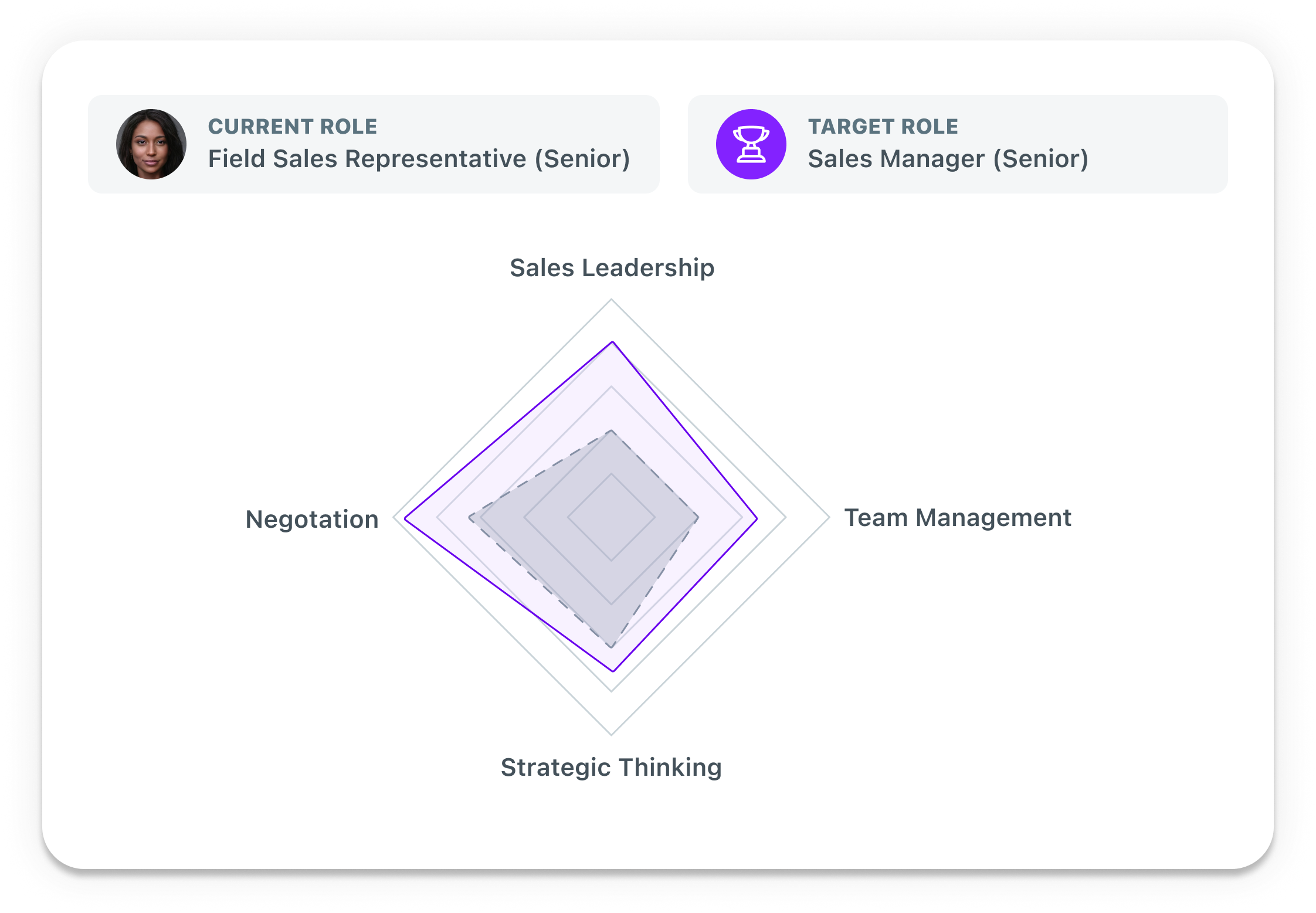
spider chart for skill profile visualisation
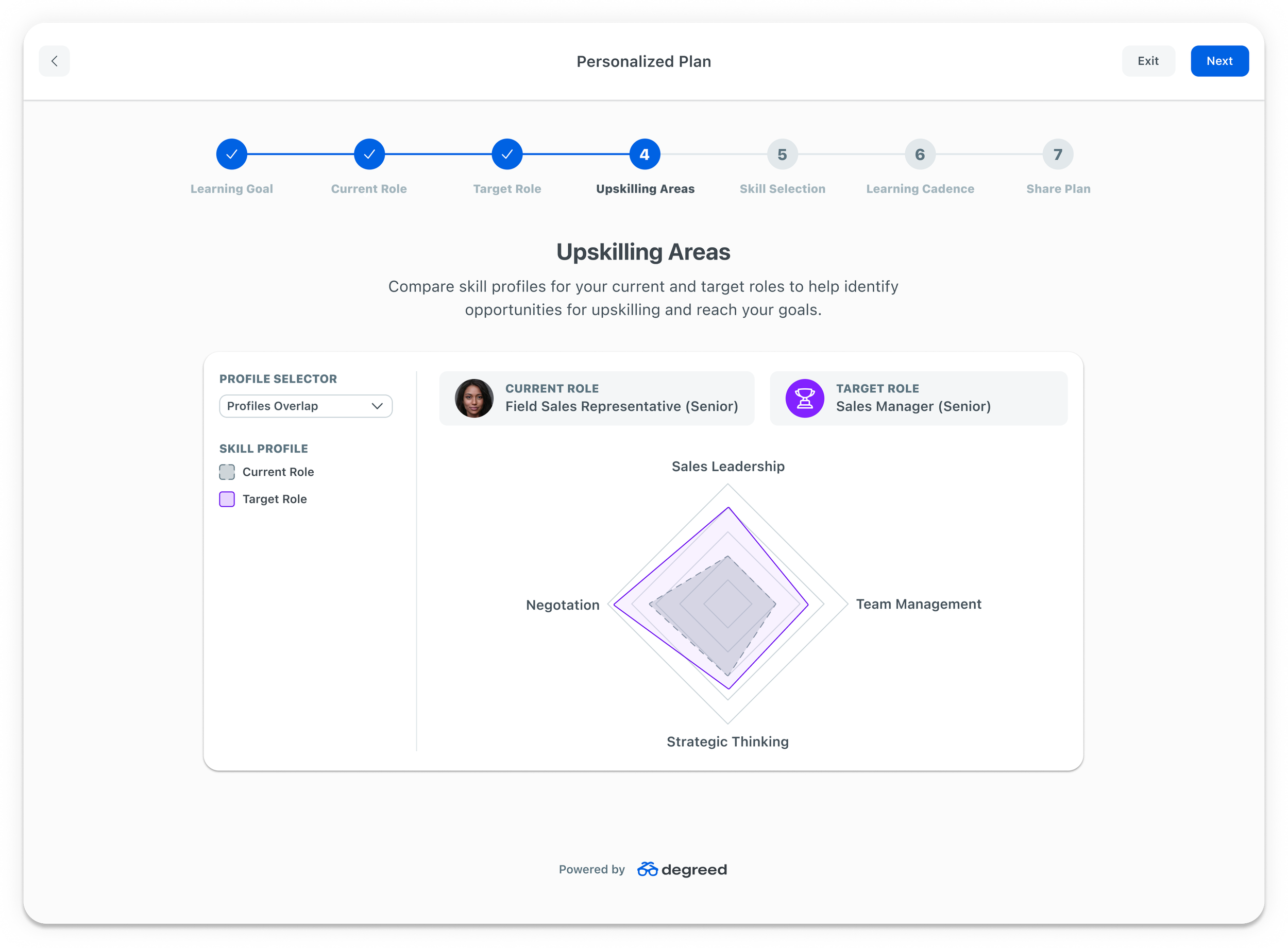
Step three: Identifying skill gaps
Step Four: Focus Skills Recommendation
In this step, Degreed provides focused skill recommendations based on the learner's chosen goals and their existing skillset. Learners can either follow these recommendations or manually search for and select additional skills they find more relevant to their learning path.
The skills selected during this stage are critical to shaping the personalised learning plan. They not only define the structure—each section focusing on one key skill—but also determine the core topics covered throughout the plan.
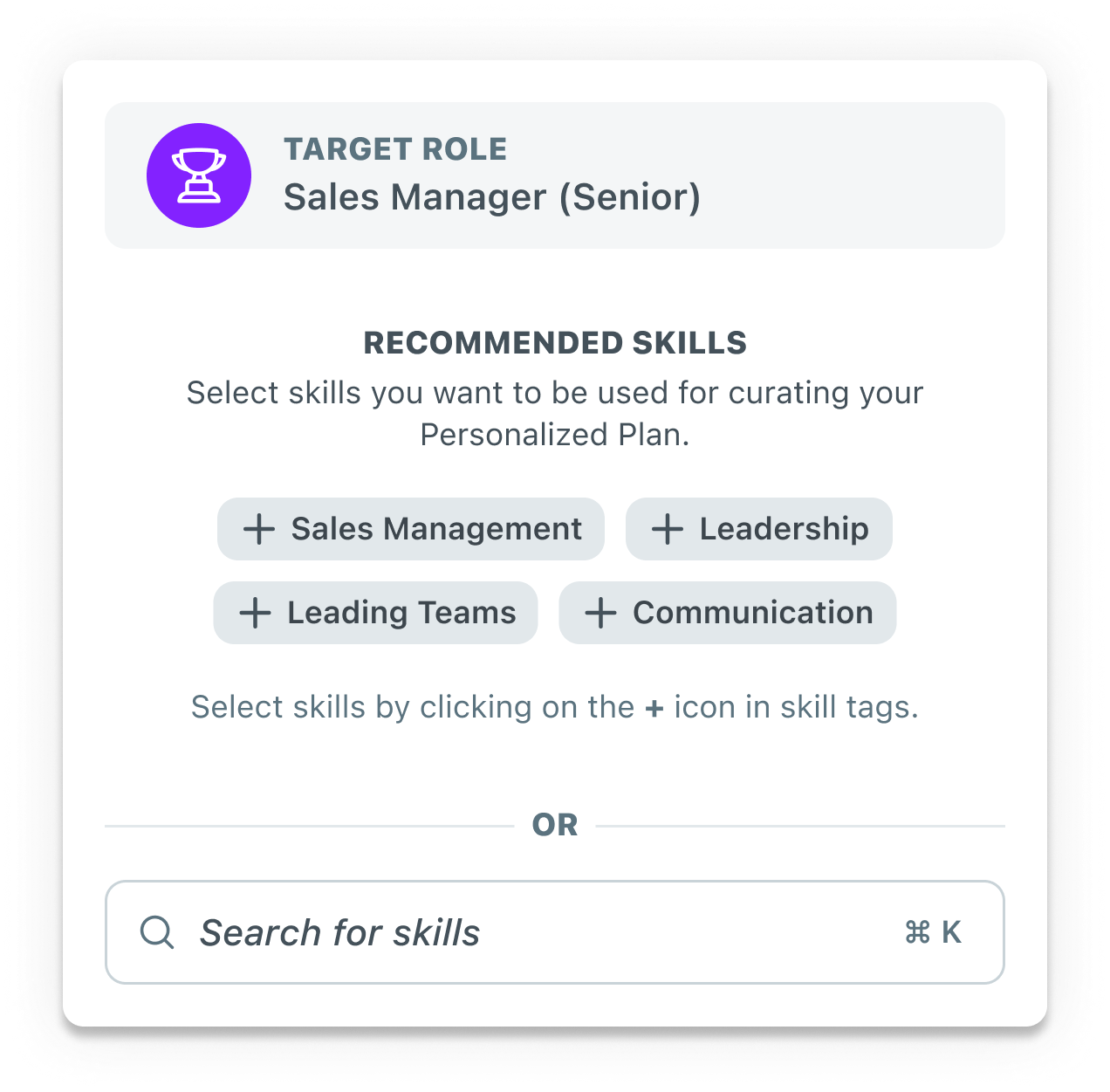
Focus skills recommendation
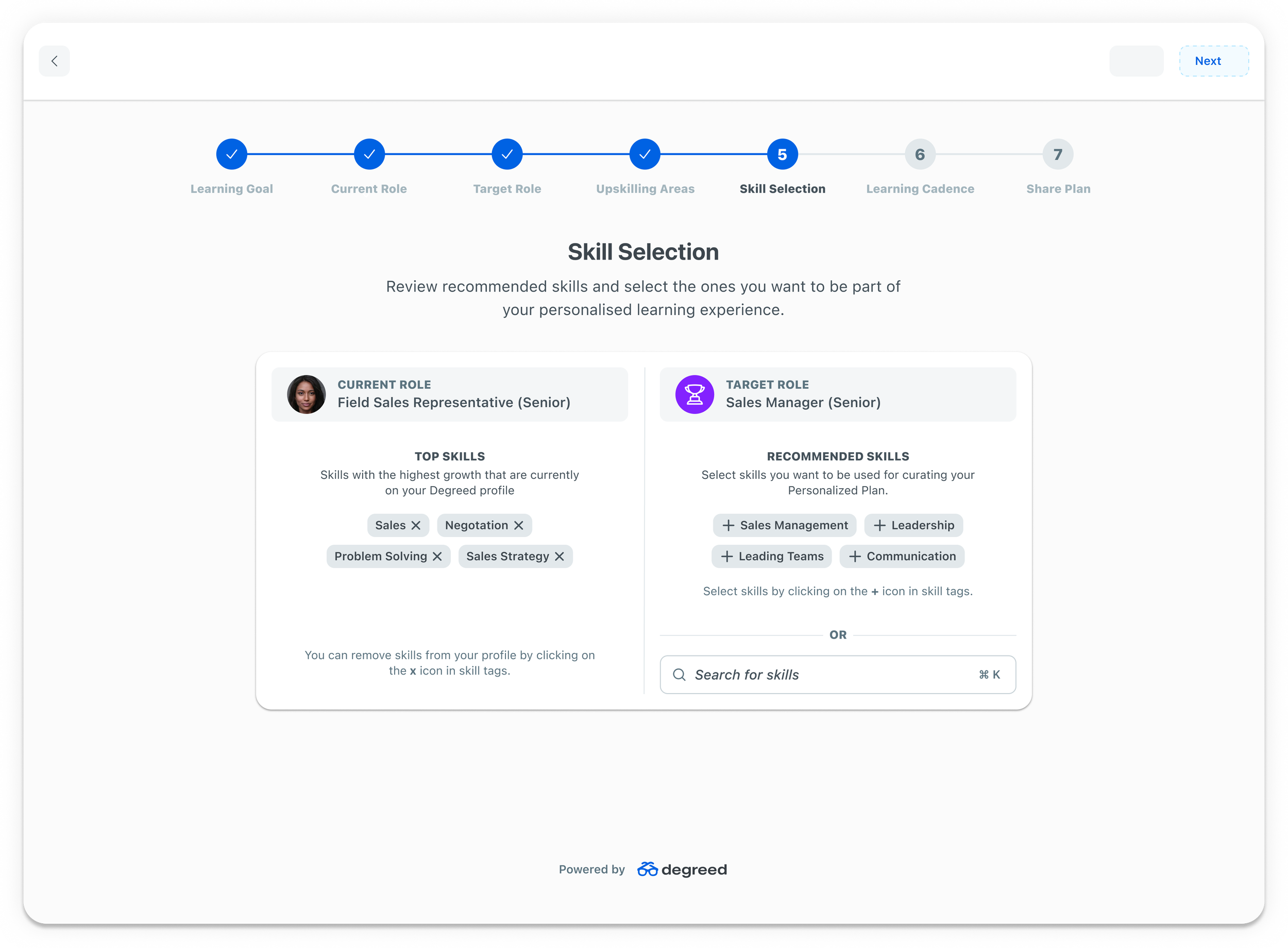
Step four: focus skills recommendation
Step Five: Learning Cadence
In this step, we ask learners to share details about their typical weekly learning cadence. This information helps us determine:
The depth of the learning plan—higher learning cadences allow for more in-depth content.
The amount of content to include in each weekly section.
For learners with shorter weekly learning cadences, we prioritise curating bite-sized learning formats (such as articles and videos) over more time-intensive options like books or courses.

Focus skills recommendation
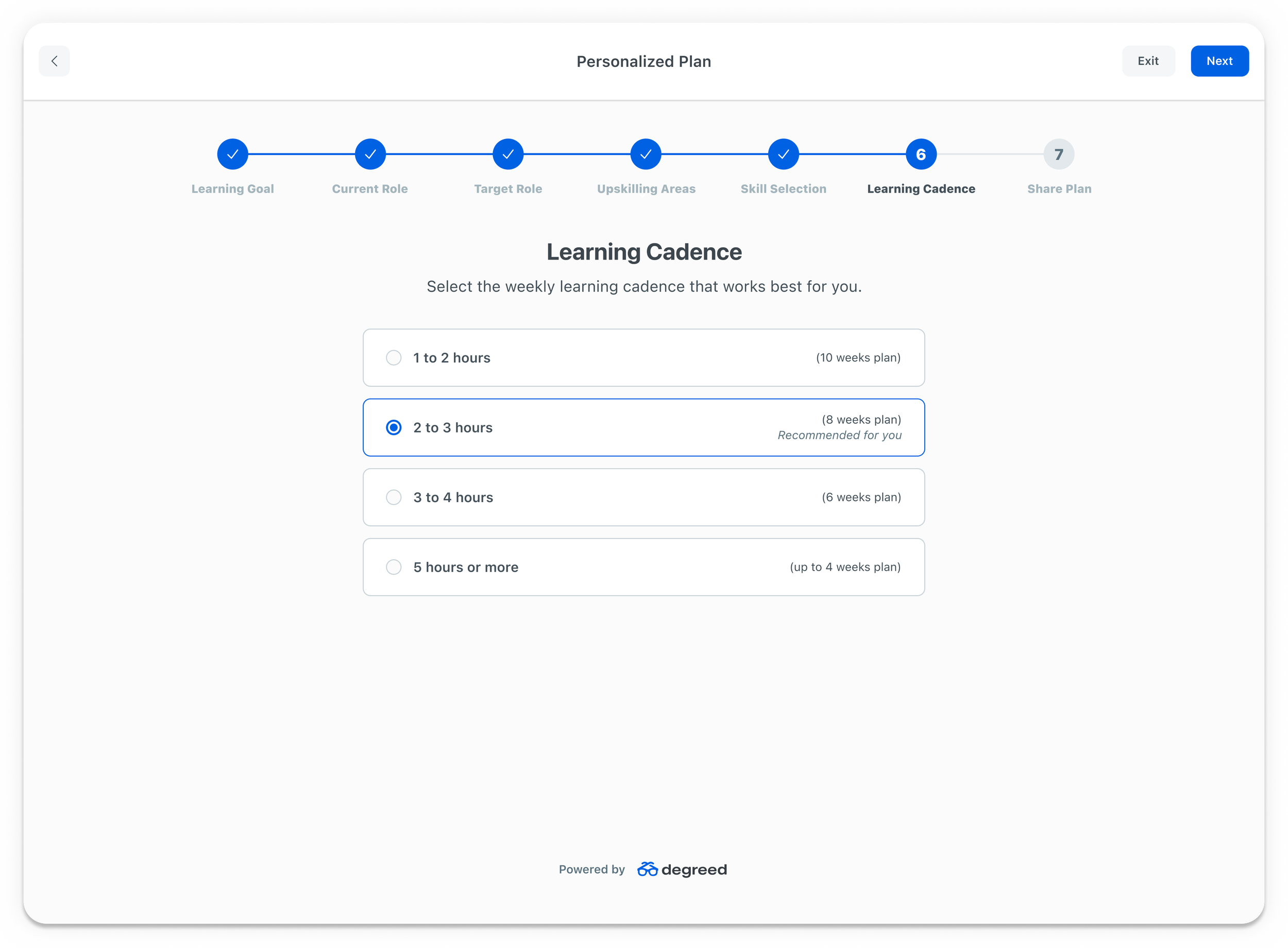
Step four: focus skills recommendation